Variable Data Printing Software: A Practical Guide
- 23 Aug, 2026

A marketing team has a production problem that looks simple until the spreadsheet arrives. It needs thousands of event badges, each with a different name, organization, photo, and QR code. The design is already approved, but copying fields by hand creates opportunities for misspellings, misplaced images, duplicate records, and outdated artwork.
Variable data printing software replaces that fragile repetition with a controlled production system. A team creates a template once, connects fields to structured data, validates the inputs, and renders a complete batch of personalized files. That basic promise is powerful, but the renderer is rarely the hardest part. Data quality, template logic, file construction, delivery tracking, and integration maintenance determine whether a VDP workflow ships cleanly.
The category has moved well beyond a niche print utility. One industry estimate values the specialized variable data printing software market at $2.47 billion in 2025 and projects $4.89 billion by 2033, an implied 8.9% compound annual growth rate, while another estimate places the market at $2,113.7 million in 2024 and projects $4,500.0 million by 2035, with a 7.1% CAGR. These are projections from separate market models, but both indicate a software segment that has crossed the billion-dollar threshold and is expected to roughly double over the following decade. DataHorizzon Research’s variable data printing software market estimate
Table of Contents
- Why Teams Turn to Variable Data Printing Software
- How Template Binding and Variable Fields Work
- Driving Batches with CSV and JSON Data
- Choosing the Right Output Formats and Standards
- The Hidden Bottlenecks Most VDP Guides Ignore
- Real-World Use Cases Across Industries
- Optimizing Production Runs for Speed and Reliability
- Building a VDP Pipeline That Actually Ships
Why Teams Turn to Variable Data Printing Software
A badge project exposes the difference between a design task and a production system. One approved layout might contain a fixed logo, event colors, legal text, and background graphics, alongside fields for a person’s name, headshot, ticket type, and QR code. A designer can make one badge quickly. Making thousands manually means repeating the same actions while hoping nobody edits a locked element or attaches the wrong image.
The same issue appears outside events. A retailer may need localized gift cards, price tags, or promotional graphics for multiple markets. An education team may issue certificates where every recipient receives a different name, course title, date, and verification code. Static design software can produce each file, but it doesn’t provide a dependable way to bind records, process a batch, retry failures, and prove which output came from which input.
The template becomes the production asset
VDP software separates composition from content. Brand elements remain fixed in the template, while approved variable fields accept data from a spreadsheet, database, CRM, or API request. The production pattern is straightforward:
- A designer builds the layout.
- The team marks text, images, QR codes, and barcodes as variable fields.
- An operator or application supplies one record per recipient or item.
- The renderer creates an output for each record.
- The workflow delivers files for review, download, distribution, or print.
This approach works because a common design doesn’t need to be rebuilt for every recipient. Historically, VDP became commercially significant as digital printing matured, since each printed piece could change from a shared data source without requiring a complete redesign. Broader market estimates reflect that transition, including a projection from $9.5 billion in 2021 to $21 billion by 2030 at more than 9% annual growth, and another projection from $11.5 billion in 2022 to $26.8 billion by 2030. The latter model assigns software a revised 12.9% CAGR in its post-pandemic forecast. Grand View Research’s variable data printing market overview
Production rule: Design once, vary only what the record actually needs to change.
The practical benefit isn’t personalization alone. A well-designed workflow gives marketing and operations teams a repeatable handoff. Designers control the visual system, data owners control records, and engineers control submission and delivery logic. The sections below focus on the parts that usually decide whether that handoff remains reliable under batch pressure.
How Template Binding and Variable Fields Work
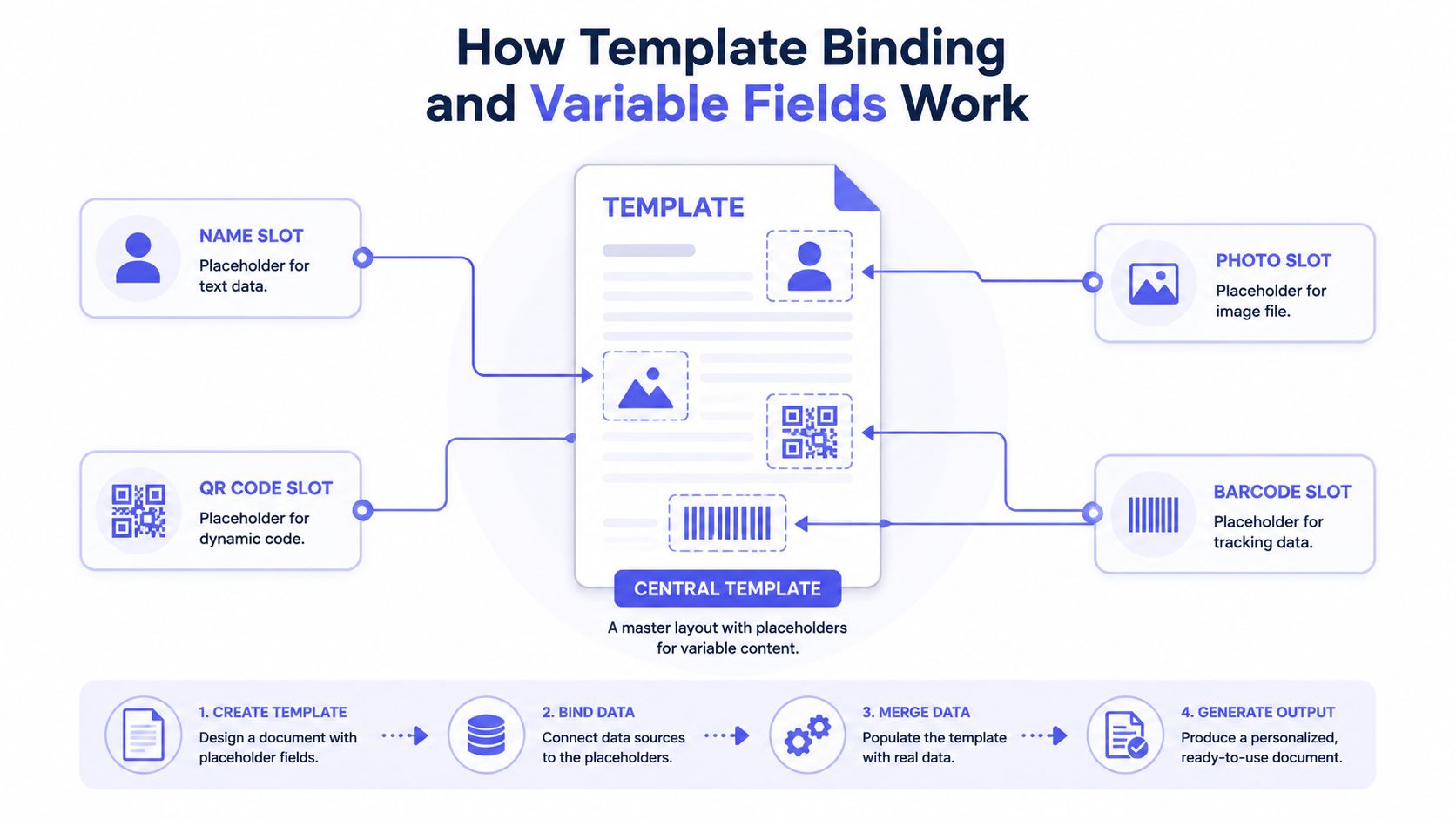
A template behaves like a form letter with carefully defined blanks. The page contains the permanent structure, while selected slots wait for values such as a name, photo, QR code, or barcode. When the renderer receives a record, it fills those slots and produces a complete document without allowing the incoming data to rewrite the entire design.
Separate fixed elements from variable fields
A dependable template starts with a strict boundary between what changes and what doesn’t. Logos, fonts, brand colors, legal copy, margins, and background artwork generally belong in the fixed layer. Names, images, dates, identifiers, and codes belong in the variable layer.
That separation prevents a common failure mode: giving an operator too much editing freedom during production. If the workflow allows someone to move a logo while uploading a CSV, the template isn’t functioning as a production control. A brand-locked design protects consistency while still allowing a non-designer to prepare records.
A visual canvas editor usually exposes fields through labels or variable tokens.
The field called recipient_name can map to a spreadsheet column with the same
meaning, while portrait_url maps to an image location. A QR field might accept
a destination value and generate the code during rendering, whereas a barcode
field may require a specific identifier format.
Treat the schema as an interface
The template schema is the contract between design and software. Developers need
to know the available variables, expected data types, required fields, and any
default values before sending a payload. Schema introspection makes those
variables visible in advance, reducing mismatches such as sending customerName
to a template expecting recipient_name.
A practical field specification should answer four questions:
- Is the field required? A missing optional subtitle may be acceptable, but a missing identifier may invalidate the output.
- What type of value does it accept? Text, image reference, date, URL, QR input, and barcode input shouldn’t be treated interchangeably.
- What happens when content is long? The template needs a defined overflow behavior, not a last-minute guess.
- Who owns the value? The designer, data steward, or calling application should have clear responsibility.
Teams can start with prebuilt variable data printing templates and then tighten the field contract before connecting production data. The software can render the page, but it can’t decide whether an empty image, an invalid URL, or a truncated name is acceptable business output. That decision belongs in the template and validation rules.
Driving Batches with CSV and JSON Data
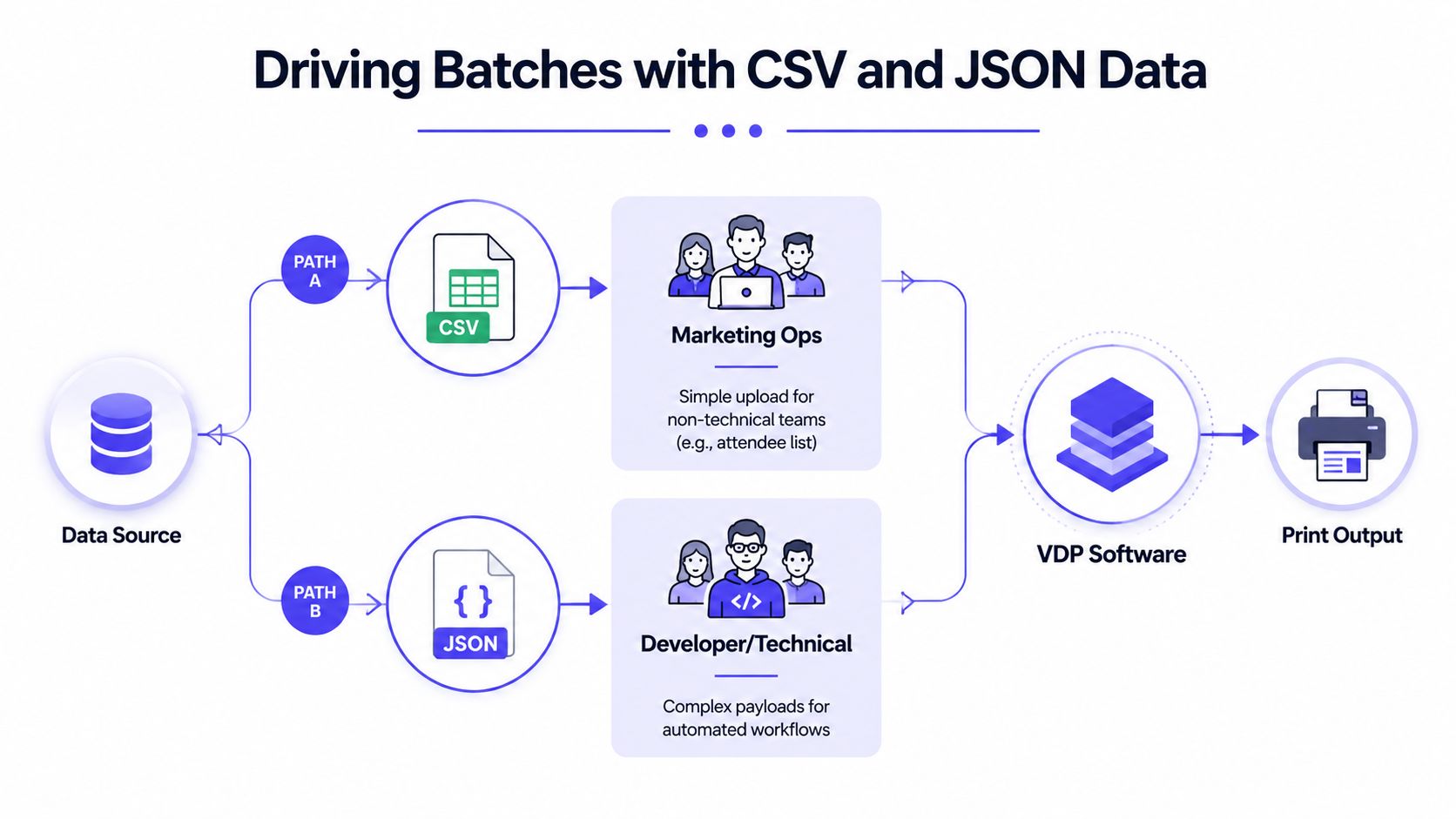
The data layer determines how easily a VDP workflow can be operated by different teams. CSV suits a human-managed batch. JSON suits an application-managed batch. Both can describe the same records, but they support different ownership models and different error-handling patterns.
CSV keeps routine operations accessible
Consider a gym producing membership cards. An operations employee exports a spreadsheet containing each member’s name, membership identifier, tier, photo reference, and barcode value. The employee uploads the CSV, selects the card template, checks a sample, and submits the batch. Each row represents one member and should produce one output file.
That workflow succeeds only when the spreadsheet is treated as structured input rather than a casual list. Column names must match the template schema, delimiters and encoding must be consistent, and image references must resolve. Blank rows, duplicate identifiers, accidental formula text, and inconsistent date formats should be caught before rendering begins.
A template for personalized shipping labels illustrates the same principle in a more operational setting. The label may combine a recipient address, order identifier, service level, and barcode, but every field needs a clear source and a predictable fallback. The batch system should report rejected rows separately instead of forcing an operator to guess which record caused the job to fail.
JSON supports event-driven automation
An application can submit the same information as a JSON payload when a CRM, order system, or membership platform triggers the render. JSON handles nested data and conditional application logic more naturally than a flat spreadsheet. It also supports a clearer relationship between the source record, template identifier, output format, and delivery preferences.
Batch APIs need operational controls, not only a render endpoint. Teams should define the maximum records accepted per submission, decide whether a job is monitored through polling or completion callbacks, and attach an idempotency key to each submission. If a network timeout causes the caller to retry, the key lets the system recognize the original request instead of generating duplicate files or duplicate charges.
Delivery can take two forms. The service may return a ZIP containing individual files, or it may provide hosted URLs with defined expiration and revocation behavior. Either option should expose record-level errors, job status, and a durable relationship between each source row and its rendered output.
Practical rule: A batch is complete only when the system can explain every accepted, rejected, and delivered record.
Choosing the Right Output Formats and Standards
Output format should follow the destination, not the convenience of the design tool. A social graphic, an Open Graph image, a badge sent to a commercial printer, and a transactional statement may all begin with the same variable fields, but they have different requirements for resolution, color, metadata, delivery, and downstream processing.
Web-oriented outputs such as PNG, JPEG, and WebP work well when a browser, email system, social platform, or content workflow consumes the result. A maintained template can generate consistent image assets without asking a generative model to recreate brand typography or layout on every request. For print, a PDF workflow is usually more appropriate because it preserves page structure and supports prepress checks.
PDF/VT belongs in production print conversations
PDF/VT is the ISO document format most directly associated with variable and transactional printing. It uses a PDF 1.6 foundation constrained by PDF/X-4 and PDF/X-5 rules, allowing composition software to preserve a common static base while varying page content, metadata, and placed assets. That combination supports variable records without abandoning established PDF production controls. PRINT Technologies’ PDF/VT standards overview
PDF/VT also reduces dependence on a vendor-specific legacy format when different composition systems, digital front ends, and prepress environments must exchange jobs. The format matters most when a print provider needs structured variable records, predictable output intent, and efficient handling of reused resources.
| Format | Best For | Resolution | Delivery |
|---|---|---|---|
| PNG | Transparent web graphics, UI assets, simple social artwork | Web or print resolution as configured | Direct file or hosted URL |
| JPEG | Photographic graphics and compact web delivery | Web or print resolution as configured | Direct file or hosted URL |
| WebP | Modern browser and content delivery workflows | Web-oriented output | Direct file or hosted URL |
| Print-ready PDF | Badges, certificates, labels, and packaging | Print production settings, including 300 DPI workflows | Download, stream, or print handoff |
| PDF/VT | Structured variable and transactional print jobs | Prepress-controlled PDF workflow | Digital front end or production exchange |
A server-side platform such as Zandovi can return PNG, JPEG, WebP, or print-ready PDF and supports outputs up to 4096 × 4096 pixels at 300 DPI, according to its stated product capabilities. That range is useful when one maintained template serves both web and print destinations, but format selection still belongs to the production owner.
The Hidden Bottlenecks Most VDP Guides Ignore
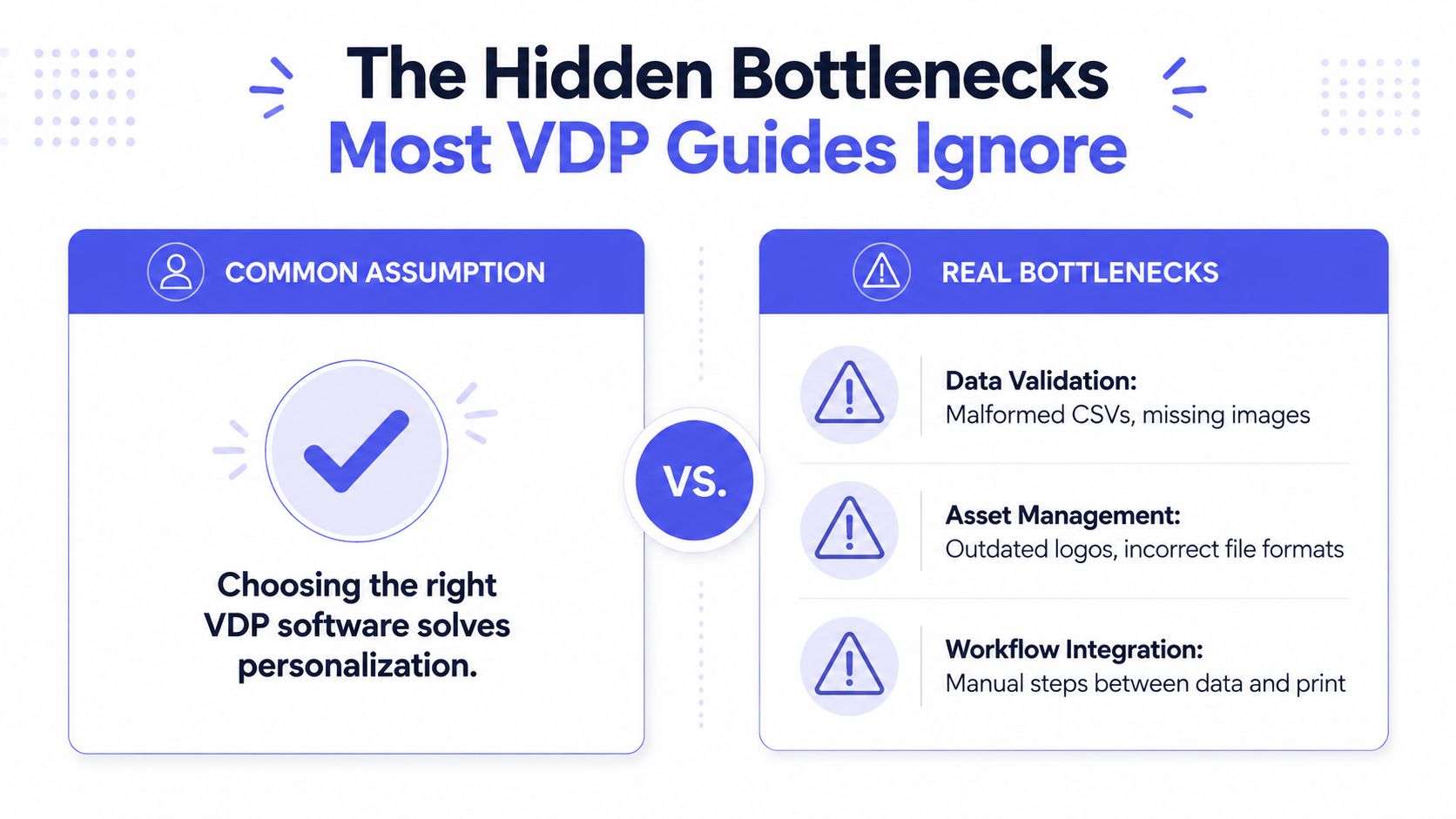
Choosing software doesn’t solve personalization. It solves one layer of the system, usually composition and rendering. The failures that stop a batch from shipping often occur earlier, when the data is incomplete, the template has too many branches, or the integration depends on manual steps.
Data validation fails before rendering begins
A malformed CSV can contain valid-looking rows that still produce unusable assets. Image URLs may be inaccessible, identifiers may contain invisible whitespace, and a field that appears numeric may lose leading characters when opened in spreadsheet software. Validation should inspect the file before submission, then preserve rejected records for correction rather than dropping them.
Template complexity creates a second class of defects. Conditional branches for language, membership tier, product type, legal copy, and image availability can turn a clean layout into a maze of interactions. Each branch expands the proofing surface, especially when text length changes the visual balance.
Integration plumbing creates the expensive surprises
An API can be technically correct and operationally brittle. A homegrown pipeline may rely on undocumented response behavior, manually copied URLs, or a callback handler that doesn’t distinguish a failed render from a delayed job. When an upstream CRM changes a field name, the renderer may continue accepting requests while producing incomplete files unless schema validation and output checks are in place.
Independent coverage identifies steep learning curves, poor documentation, limited exporting, and integration problems among ongoing user difficulties. The same coverage frames personalization as an infrastructure problem, with respondents citing cost at 49%, budget limits at 38%, and difficulty measuring campaign effectiveness at 30%. Those figures don’t prove that one vendor or one architecture will fix the problem, but they do support a broader conclusion: teams struggle with the surrounding system, not only the design editor. Coverage of recurring VDP problems and infrastructure concerns
A workable governance model includes:
- Input checks: Reject missing required fields, invalid asset references, and duplicate business identifiers before rendering.
- Template review: Test long names, absent images, alternate languages, code readability, and conditional paths.
- Proofing rules: Approve representative records and retain the template version used for production.
- Delivery observability: Track job status, callback delivery, output retrieval, and record-level failures.
- Ownership boundaries: Assign responsibility for data, template changes, integration code, and final approval.
The renderer is rarely the only bottleneck. Data plumbing and approval governance decide whether the renderer can be trusted.
Real-World Use Cases Across Industries
The strongest VDP workflows share a pattern. A team defines a stable visual system, identifies the fields that vary, and connects the template to the system that already owns the data. The output might be a printed document, a downloadable file, or a web image, but the operating model stays consistent.

Event organizers use VDP software for badges, tickets, passes, and check-in materials. A single template can bind the attendee’s name, organization, access category, headshot, and QR code. The event system supplies the records, while the production team reviews representative outputs and prints the approved batch.
Educational programs use the same structure for certificates. Course names, recipient names, completion dates, instructor details, and verification codes can vary without allowing operators to change the underlying identity of the program. Teams can begin with certificate templates for variable output and then connect the fields to enrollment or completion data.
Retail and packaging teams apply VDP to localized price tags, gift cards, inserts, and short-run packaging. A product identifier, market language, price, promotional message, or scannable code can change from record to record while logos, typography, and regulatory content remain controlled.
Membership organizations, gyms, and clubs generate cards with member IDs, tier labels, expiration information, photos, and barcodes. The critical requirement is traceability. An organization needs to know which source record created a card and whether a correction requires a new render or a replacement print.
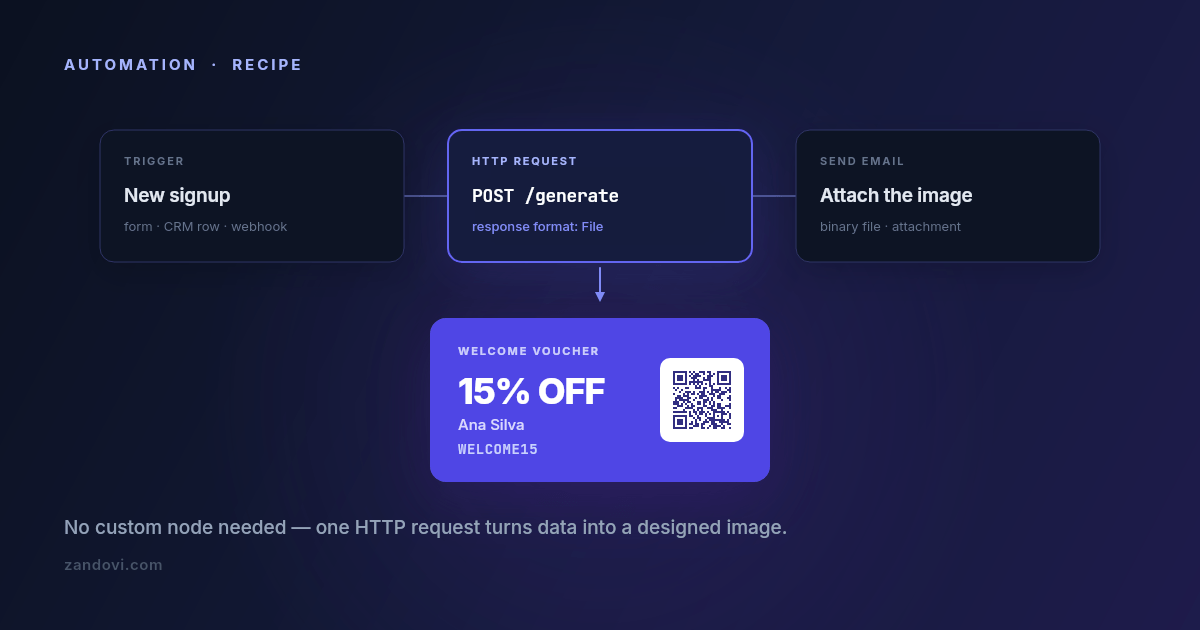
Automation extends these use cases beyond the print queue. A CRM, n8n, Make, or Zapier can trigger an asset when a record changes, then send the resulting file to an email, content, or fulfillment workflow. The same template may produce a 1080p social graphic for a campaign or a 300 DPI print-ready PDF for physical distribution, provided the layout has been designed for both destinations.
A practical demonstration can show the full sequence, from variable fields to personalized output:
The common thread isn’t the industry. It’s the replacement of manual repetition with a controlled template, validated records, automated rendering, and a delivery path that people can inspect.
Optimizing Production Runs for Speed and Reliability
High-volume VDP performance depends heavily on file structure. If every record embeds a fresh copy of the same logo, background, font, or decorative element, the PDF becomes heavier than necessary and the digital front end must process repeated content unnecessarily. Minimizing per-record variation and preserving reusable objects reduces file-processing overhead.
Independent PDF/VT guidance recommends using available hints and warns composition-tool operators to avoid inefficient PDF files. The technical implication is direct: cleaner construction and object reuse help a RIP or DFE process personalized batches at production speed. PDF Association guidance for creating VDP print files
Build for reuse before adding concurrency
Template authors should keep static content shared wherever the production system supports it. Variable image treatment should be deliberate, because a unique high-resolution image on every record can dominate processing even when the rest of the page is reusable. A preflight step should check image dimensions, transparency, font embedding, bleed, and barcode placement before a large job starts.
Application architecture matters too:
- Parallel rendering: Send independent requests concurrently when the service and downstream systems support it.
- Caching: Reuse repeated elements and already-generated assets instead of rendering identical content repeatedly.
- Idempotency: Attach a stable key to each batch submission so retries don’t create duplicate work.
- Signed callbacks: Use HMAC-signed webhooks and verify the signature before updating job status.
- Failure accounting: Record failed rows independently and preserve enough context for a targeted retry.
A delivery callback should be treated as a state transition, not as a casual notification. The receiving application needs to distinguish queued, processing, completed, expired, and failed states, then handle repeated callback delivery safely.
A fast render that can’t be reconciled is still a production failure.
Transparent metering also matters during large runs. Automatic refunds for failed renders and usage tracking that counts automation clearly help teams reconcile invoices with output, especially when retries and partial failures occur. Reliability is a combination of throughput, clean files, recoverable errors, and understandable billing.
Building a VDP Pipeline That Actually Ships
A team evaluating VDP software should start with the workflow rather than the feature list. A managed API can handle rendering, scaling, file delivery, callbacks, and batch coordination without requiring the team to operate a headless browser fleet or maintain a custom HTML-to-image stack. A homegrown system may offer deeper control, but it also makes the team responsible for renderer upgrades, concurrency behavior, retries, asset handling, and output validation.
The decision should turn on a few practical questions:
- Can the system expose its template schema before integration?
- Can it accept both operator-friendly CSV files and application-ready JSON?
- Does it prevent duplicate work when a request is retried?
- Can it report partial failures clearly?
- Does it support the required web and print formats?
- Can workspace administrators manage roles, API keys, and usage?
For teams considering a managed option, Zandovi provides a visual template editor, variable binding for text, images, QR codes, and barcodes, CSV and JSON batch workflows, hosted delivery options, schema introspection, idempotency keys, signed webhooks, and usage tracking. Those capabilities address different stages of the pipeline, but they don’t replace data ownership or proofing discipline.
The target isn’t personalization for its own sake. It’s predictable throughput, controlled templates, traceable records, and delivery status that an operator can understand. Audit the current data plumbing, remove unnecessary template branches, validate a representative batch, and choose infrastructure that makes retries, metering, and failed renders visible before the next production run.